Why Does Loungewear Pill So Fast, and Which Fabrics Do Not?
Quick Answer: Most loungewear softness comes from brushing or napping the fabric, which mechanically raises fiber ends to the surface. Those raised ends are exactly what tangles into pills under friction. Fabrics that resist pilling are long-staple cotton in a smooth jersey or interlock, high-quality modal and lyocell, tightly knit ribs, and merino in a smooth finish. The worst offenders are polyester fleece, brushed poly-blend jersey, low-grade viscose, and anything described as microfleece or plush.
A pair of loungewear trousers that felt extraordinary in the shop looks tired after six weeks. It is the most common complaint about the category, and it has a straightforward explanation.
You paid for raised fibers, and raised fibers are what pilling is made of.

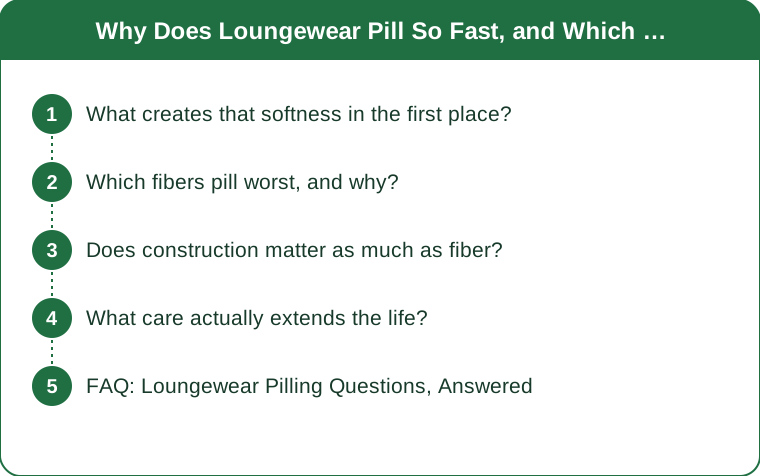
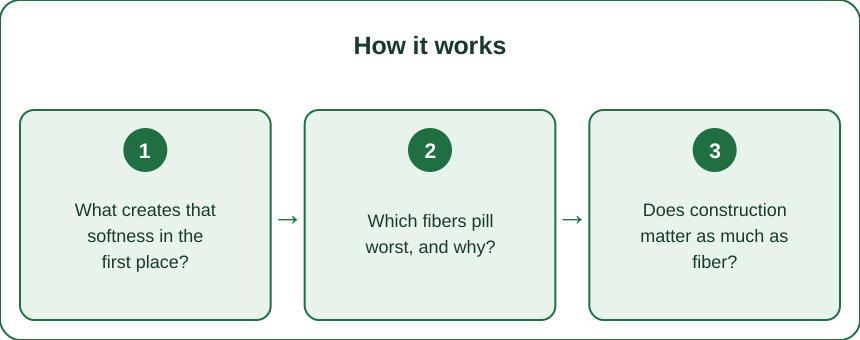
What creates that softness in the first place?
Usually a mechanical finishing process, and understanding it explains everything downstream.
Brushing, also called napping, drags fine wire brushes across the fabric surface to pull fiber ends out of the yarn. The result is a fuzzy, warm, soft face. It is used on fleece, brushed jersey, brushed cotton, and most things described as buttery or cloud-like.
Peaching is a gentler version producing a suede-like hand.
Sueding and sanding use abrasives for similar effect.
All of these work by damaging the fabric surface in a controlled way. The fibers standing proud of the surface are already partly detached from the yarn structure.
Then friction finishes the job. Sitting, moving, washing, and rubbing tangle those raised ends into balls. In synthetics, the anchoring fibers are strong enough that the balls stay attached, so the fabric looks worse rather than shedding.
The trade-off, stated plainly: the property you are buying and the failure mode are the same property. A genuinely soft brushed fabric that does not pill is largely a marketing claim rather than a material one.
Which fibers pill worst, and why?
Fiber length and fiber strength together determine the outcome.
Worst performers:
- Polyester fleece and microfleece. Heavily brushed and made of strong fibers, so pills form quickly and never leave. The category with the shortest attractive lifespan.
- Brushed poly-cotton jersey. Common in inexpensive loungewear. The polyester holds pills while the cotton contributes short loose ends.
- Low-grade viscose and rayon. Weak fibers that break easily, plus a soft finish. Pills form and the fabric thins.
- Short-staple cotton. More fiber ends per unit of yarn means more available material to work loose. This is why cheap cotton pills and good cotton does not, at the same apparent softness.
- Chenille and boucle knits. The construction is loose loops by design.
Best performers:
- Long-staple cotton in a smooth jersey, interlock, or rib. Fewer exposed fiber ends because each fiber spans more of the yarn. Look for combed cotton, Supima, or Egyptian.
- Lyocell, often branded Tencel. Smooth, strong, resists pilling well, and drapes beautifully. One of the best choices in this category.
- Good-quality modal, similar reasoning.
- Merino in a smooth finish, which resists odor as a bonus. Avoid brushed merino, which pills like anything else brushed.
- Tightly knit ribs and interlocks in any decent fiber, because the dense structure holds yarns in place.
A note on the label vocabulary: brushed, plush, fleece, sherpa, teddy, velour, microfiber, and buttery all indicate raised surfaces. Jersey, interlock, rib, sateen, and smooth all indicate flat ones. The words on the tag genuinely predict the outcome.

Does construction matter as much as fiber?
Nearly, and it is the part most buying guides skip.
Knit density. A tightly knit fabric holds its yarns in place, so fibers cannot migrate to the surface. Hold a garment up to light: if you can see through the knit structure clearly, it is loose and will pill sooner.
Fabric weight. Heavier fabrics at the same fiber quality generally last longer, since there is more material per unit of surface friction. Very lightweight soft knits are the shortest-lived.
Yarn twist. Higher-twist yarns hold fibers more securely. You cannot see this directly, and it correlates with price and with descriptions like compact or combed.
Single jersey versus interlock. Interlock is a double-knit structure, denser and much more pill-resistant than single jersey at the same weight. Worth looking for on the label.
Where pills appear tells you the friction map:
- Inner thighs and seat: sitting and walking. Universal.
- Under the arms and inner sleeves: arm movement against the body.
- Anywhere a bag strap crosses. A single crossbody strap can pill a jumper in weeks.
- The back of a top, if you sit against upholstery. Fabric-on-fabric with a textured sofa is unusually abrasive.
Which points at a fix nobody mentions: if your loungewear pills mainly on the back and seat, your sofa fabric is a major contributor. A throw over a textured or bouclé sofa reduces it noticeably.
What care actually extends the life?
The same rules as technical fabric, with one addition.
Wash inside out. Protects the outer face from the drum and from other garments. Highest-value single change.
Cool water and a gentle cycle. Heat and agitation both accelerate fiber migration.
Half the usual detergent, and no fabric softener. Softener coats fibers and traps residue, and its perceived softness is a coating rather than an improvement.
Never wash with towels, denim, or zippers. Terry is abrasive, denim more so, and hardware worst. This causes a large share of avoidable pilling.
Air dry. A hot dryer is 40 minutes of concentrated tumbling abrasion, plus heat damage to elastane. This is the change with the biggest effect after washing inside out.
Wash less often. Loungewear worn indoors over other clothes does not need washing after every wear. Every three to four wears is reasonable for most pieces, and every wash cycle is a friction event.
The addition specific to loungewear: rotate more than you think. Three sets rotated last far longer than one set worn nightly, because the total friction per garment drops and fibers recover between wears.
On removing pills: a fabric shaver works, and it removes material permanently and thins the fabric slightly each pass. Once or twice per garment lifetime is reasonable. A sweater comb is gentler for knits. Never use scissors or a razor on stretch fabric.
Seasonal note: the shift into fall is when brushed and fleece loungewear comes out of storage and starts accumulating wear hours again, often daily. If you are choosing new pieces for the season, this is the decision point: a smooth interlock or lyocell set will still look good in March, and a plush fleece set will not. That is worth knowing before you buy rather than in February.
FAQ: Loungewear Pilling Questions, Answered
Why does my loungewear pill so quickly?
Because the softness is usually created by brushing, which raises fiber ends to the fabric surface. Those raised ends tangle into pills under friction, and in synthetic fibers the pills stay attached rather than shedding.
What loungewear fabric does not pill?
Long-staple cotton in a smooth jersey or interlock, lyocell, good modal, tightly knit ribs, and smooth-finish merino. Avoid anything described as fleece, plush, brushed, teddy, or microfiber.
Does expensive loungewear pill less?
Only when the price reflects fiber length, yarn quality, and knit density. Plenty of expensive loungewear is heavily brushed for softness and pills quickly. Read the fabric description rather than the price.
Can I stop loungewear from pilling once it starts?
You can remove pills with a fabric shaver, which thins the fabric slightly each time. Prevention works better: wash inside out in cool water, no softener, air dry, and never with towels or denim.
TL;DR:
- Loungewear softness usually comes from brushing, which raises fiber ends. Those raised ends are the raw material of pilling.
- Worst: polyester fleece, brushed poly-cotton, low-grade viscose, short-staple cotton. Best: long-staple cotton, lyocell, good modal, tight interlocks and ribs.
- Label words predict outcomes. Brushed, plush, teddy, and microfiber mean raised. Jersey, interlock, and rib mean flat.
- Wash inside out, cool, half the detergent, no softener, air dry, and rotate three sets rather than wearing one.
If you want loungewear that still looks good in spring, choose a smooth interlock over a plush fleece. You give up some initial softness and keep the garment.
See It in Motion
Seen here: High Waist Jogger Sweatpants with Pockets — shop it on bubblelime.com
Keep Reading
This article is for general informational and styling purposes only. Fit, sizing, and product availability may vary.